The UK hospitality sector saw significant cost and operational pressure in 2025, and 2026 hasn't let up. Staffing costs continue to rise, energy prices remain elevated, and ingredient inflation has made menu engineering a near-monthly exercise for many operators. Against this backdrop, more independent restaurant owners are asking a question they might have dismissed a few years ago: what can technology actually do to reduce my operating costs?
Not technology as a concept — but specific, measurable tools that reduce hours spent on admin, improve staff productivity, and eliminate the manual processes that eat into every service.
Here's a practical audit of where the biggest operational wins are.
The Hidden Cost of Manual Processes
Before looking at solutions, it's worth quantifying the problem.
Research from the Hospitality Technology Consortium suggests that the average independent restaurant spends 6–8 hours per week on tasks that could be fully or partially automated: answering phone reservation requests, confirming bookings by email, updating availability manually, and chasing no-show notifications.
At minimum wage (£12.21/hour in April 2026), that's £73–£98 per week in staff time — £3,800–5,100 per year — spent on tasks that a well-configured reservation system handles automatically.
That's before accounting for errors: double bookings, missed special occasion notes, or guests who couldn't get through by phone and booked somewhere else.
Area 1: Reservations and Front-of-House Admin
What gets automated:
- Online bookings received and confirmed without staff involvement
- SMS and email reminders sent automatically 24–48 hours before the reservation
- Cancellations and modifications handled via self-service links
- Post-visit follow-up emails triggered automatically after each completed visit
Time saved:
3–5 hours per week for most restaurants currently taking bookings by phone.
Operational impact beyond time:
Automated reminders typically reduce no-shows by 30–60%. For a 50-cover restaurant losing 7% of covers to no-shows, that's recovering 2–3 covers per service. At an average spend of £40–£60 per head, that's £160–£360 recovered per busy service.
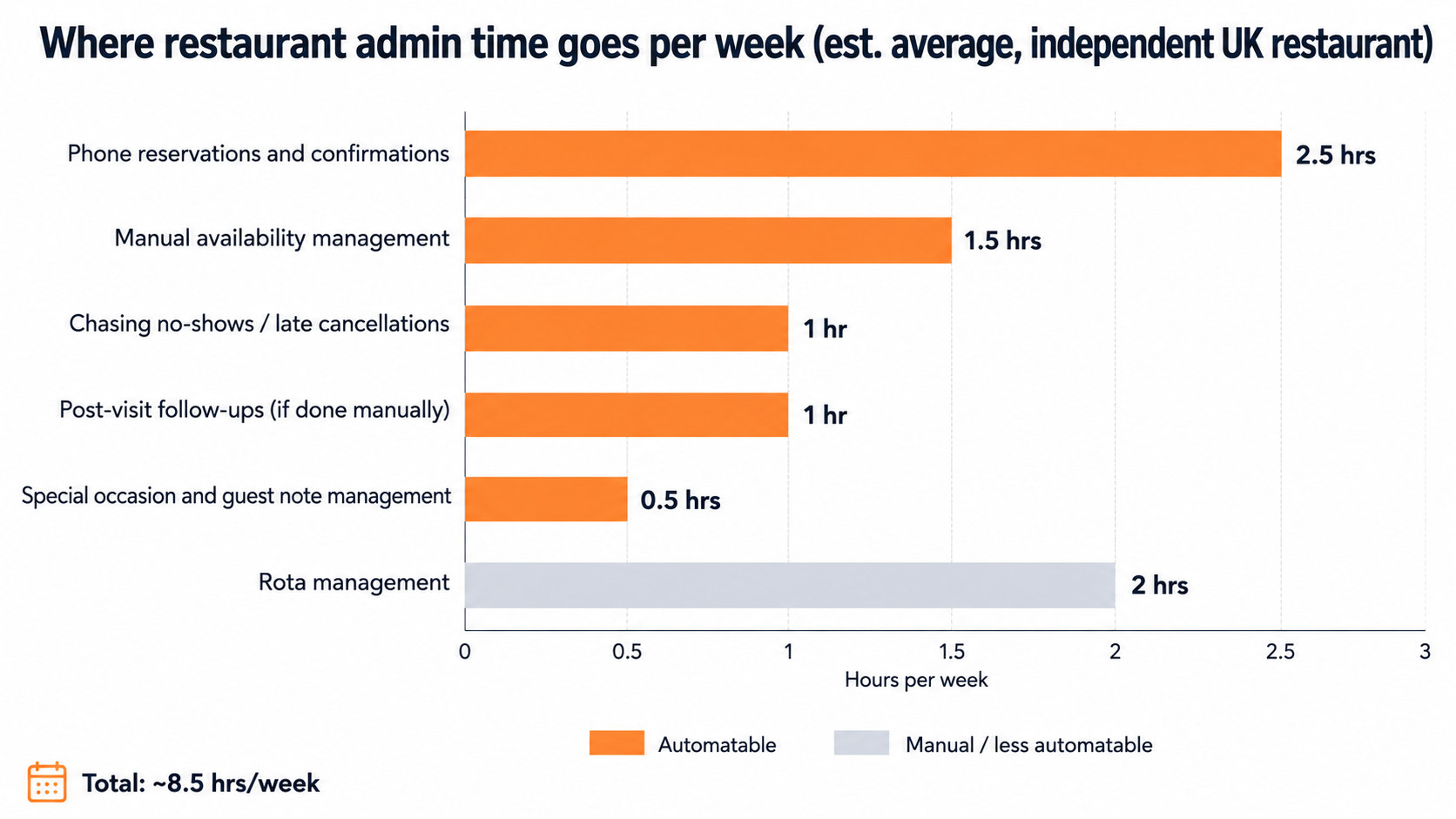
A horizontal bar chart or time-allocation visual:
"Where restaurant admin time goes per week (est. average, independent UK restaurant)"
- Phone reservations and confirmations: 2.5 hrs
- Manual availability management: 1.5 hrs
- Chasing no-shows / late cancellations: 1 hr
- Post-visit follow-ups (if done manually): 1 hr
- Special occasion and guest note management: 0.5 hrs
- Rota management: 2 hrs
Total: ~8.5 hrs/week
Highlight the first four bars in brand red/amber to indicate 'automatable'. Source: estimated based on industry surveys.
Area 2: Staff Scheduling
Rota management is consistently cited as one of the most time-consuming back-office tasks. The tools that make the most difference:
Rota scheduling apps (Rotaready, Planday, 7shifts) integrate with booking data to suggest staffing levels based on anticipated covers. Rather than building a rota from memory or gut feel, you can see that Friday's lunch service has 34 bookings confirmed and plan accordingly.
Overtime tracking built into your scheduling tool flags when a staff member is approaching contracted hours, reducing surprise wage bill increases.
Realistic saving: 1.5–2 hours per week on rota management, plus reduced overstaffing on quiet services.
Area 3: Ordering and Wastage
Food waste is one of the most preventable costs in a restaurant, and reservation data directly informs how to reduce it.
When you know 72 hours out that Saturday evening has 48 confirmed covers, you order accordingly. When you see that a particular evening is 60% booked with no movement in 48 hours, you plan a slightly tighter mis en place.
This isn't sophisticated analytics. It's using booking data you already have to make better purchasing decisions. Restaurants that actively manage their ordering around confirmed reservation data typically report a 10–18% reduction in food waste cost.
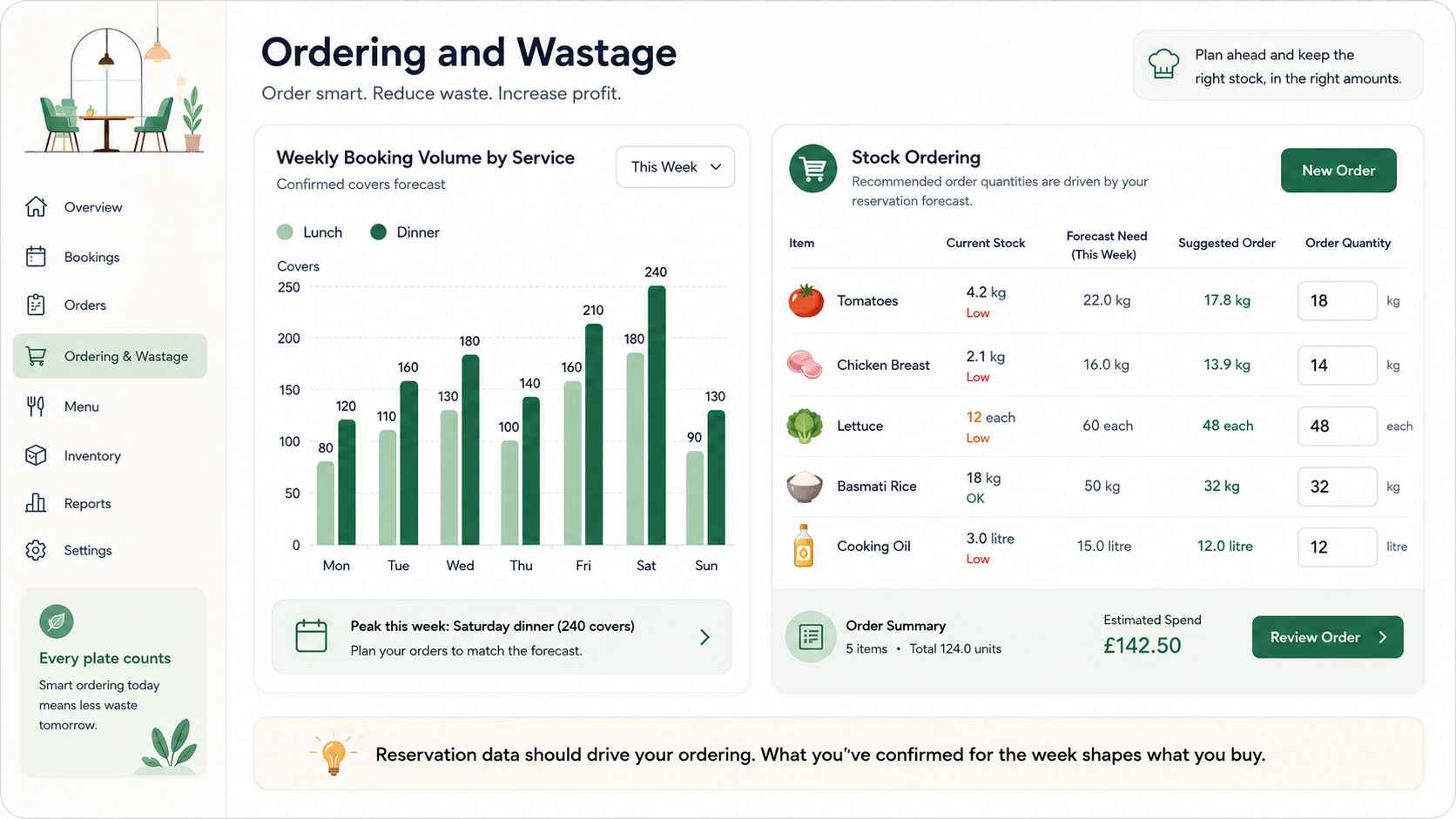
A clean dashboard view (can be a mockup/stylised graphic) showing:
- Left panel: The week's booking volume by service (Mon–Sun, lunch and dinner bars)
- Right panel: A stock order form, with quantities tied to the booking forecast
Caption: "Reservation data should drive your ordering. What you've confirmed for the week shapes what you buy."
Area 4: Guest Communications
Phone calls for reservations take roughly 3–4 minutes each. An automated online booking system handles the same interaction in 90 seconds of the guest's time and zero seconds of yours.
Beyond reservations, consider:
- Automated birthday and anniversary prompts based on guest occasion data — triggers a personalised outreach without any manual effort
- Waitlist management that notifies guests automatically when a cancellation opens a slot, filling tables without phone calls
- Pre-visit messages reminding guests of parking, dress code, or any pre-orders they need to confirm
What This Looks Like in Practice
A 40-cover restaurant in the East Midlands implemented online booking, automated reminders, and a post-visit follow-up sequence in Q1 2025. Within three months:
- Phone reservation calls dropped by 65%
- No-show rate fell from 9.2% to 2.4%
- Front-of-house manager reclaimed 4.5 hours per week previously spent on phone and admin
- Repeat visit rate increased 18% as a result of the follow-up sequence
None of this required new staff, a bigger marketing budget, or a technology overhaul. It required choosing the right tools and configuring them properly.
How Tablemap Handles the Operational Layer
Tablemap automates the reservation, reminder, and follow-up process from a single dashboard. The result is an independent restaurant that operates with less admin overhead, fewer missed covers, and better guest data than restaurants using manual processes.