No-shows are one of the most damaging and least discussed problems in UK restaurants. Industry data suggests average no-show rates of 7% — but during peak periods, some restaurants report rates of 12–15%. That's not just lost revenue for that table. It's lost revenue that was protected from other bookings, can't be recovered, and affects staff morale and kitchen planning.
Deposits are the most effective tool for reducing no-shows. But implementing them incorrectly — wrong amount, wrong wording, wrong timing — can cost you legitimate bookings and damage your brand.
Here's what you actually need to know.
What Are the Options?
There are three approaches restaurants commonly use:
1. Full pre-payment: The guest pays the full cost of the meal (or a fixed-price menu) upfront. Common for tasting menus, special events, and high-demand sittings. Eliminates no-shows almost entirely.
2. Partial deposit: A fixed amount per head (typically £10–£25) taken at the point of booking, deducted from the bill on arrival. Reduces no-shows significantly and filters out low-commitment bookings.
3. Credit card guarantee: No money is charged at booking, but the guest's card details are held. A no-show fee is charged only if they fail to arrive or cancel within the agreed window. Lower friction at the point of booking, but requires clear communication and consistent enforcement.
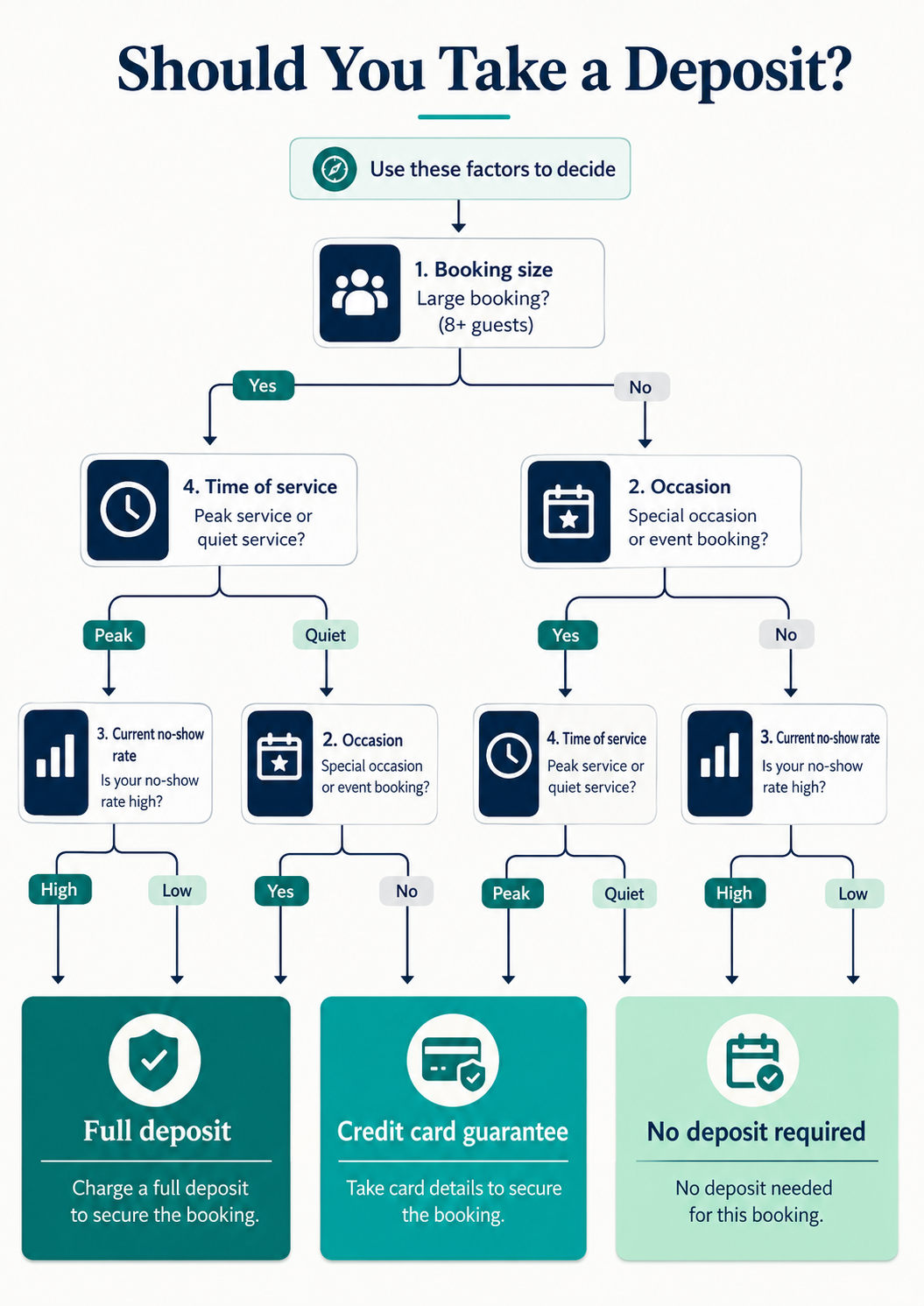
A decision-tree diagram:
Start: "Is this a booking of 6+ people?" → Yes → Take a deposit/CC guarantee
→ No → "Is it a peak period (Friday/Saturday evening) or a special event?"
→ Yes → Consider CC guarantee or partial deposit
→ No → "What is your current no-show rate?"
→ Above 8% → Introduce deposits across all bookings
→ Below 8% → Standard booking, monitor and review
Keep clean, readable, Tablemap brand colours.
When Should You Take a Deposit?
As a general framework:
Always use a deposit or card guarantee for:
- Groups of 6 or more
- Special occasion bookings (restaurant-confirmed Christmas, Valentine's, NYE)
- Tasting menu or fixed-price event sittings
- Private dining and exclusive use
Consider a credit card guarantee for:
- Friday and Saturday evening sittings
- Any booking where a no-show would result in more than 3 empty covers
Standard booking (no deposit) is appropriate for:
- Tables of 1–4 during quieter services
- Lunch covers during weekdays
- Regulars with a strong booking history
Your own no-show data should drive this decision. If you're seeing consistent no-shows from 2-person lunchtime bookings, expand your deposit policy. If your no-show problem is concentrated in large Saturday evening groups, start there.
How Much Should You Charge?
For a partial deposit, the sweet spot for most independent UK restaurants in 2026 is £10–£20 per person. This is enough to deter casual no-shows without feeling like a barrier to genuine bookings.
For credit card guarantees, a no-show fee of £20–£35 per person is appropriate for most venues. The higher the per-head cost of your menu, the more justified the higher end becomes.
For pre-payment (tasting menus, events), charge the full menu price at the point of booking. Guests booking a £95-per-head tasting menu understand the commitment they're making.
How to Communicate It Without Putting Guests Off
This is where most restaurants go wrong. A deposit policy that feels punitive or distrustful will cost you bookings. The framing matters enormously.
Don't say:
"A £15 non-refundable deposit is required to secure your booking."
Do say:
"To confirm your table, we ask for a small deposit of £15 per person, which is deducted from your bill on the night. Cancellations made with more than 48 hours' notice are fully refunded."
The second version communicates the same policy but frames it as a confirmation mechanism, not a punitive measure. It also makes the refund condition immediately clear, which removes the most common objection.
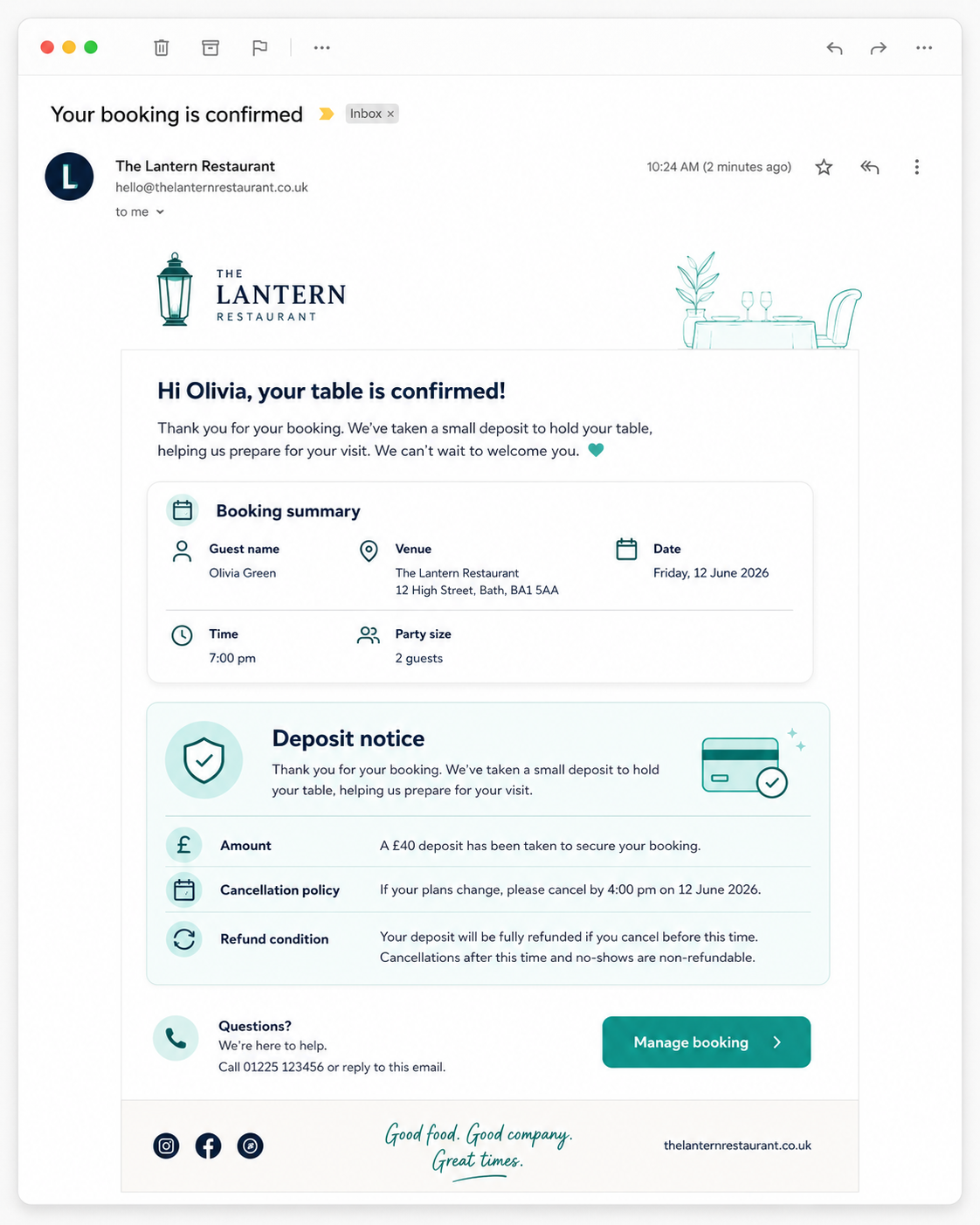
A clean email mockup showing:
Subject: "Your booking at [Restaurant Name] is confirmed"
Body: Confirmation details, then a box titled "About your deposit" with the policy clearly explained in friendly, readable language.
Design should feel warm and professional, not legalistic. Show refund condition prominently.
Handling Cancellations and Disputes
The key is having a clear, written policy that the guest confirms at the point of booking.
Your policy should state:
- The deposit amount
- The cancellation window (typically 24–72 hours)
- What happens to the deposit if they cancel within the window
- The no-show policy if they don't cancel at all
For genuine emergencies, use judgement. Refunding a deposit when a guest's family has had a medical crisis costs you £30 and earns you significant goodwill. Being rigid in those situations costs you a customer permanently.
The Numbers
Restaurants that implement deposits consistently typically see no-show rates drop from an industry average of 7% to 1–2%. For a 50-cover restaurant doing 200 covers per week, that's recovering 10–14 covers per week that were previously lost — without adding a single new customer to the pipeline.
How Tablemap Handles Deposits
Tablemap's booking flow supports Stripe-powered deposits and credit card guarantees, configurable by booking size, time of service, and occasion type. The policy is displayed to guests during the booking process and included in confirmation emails automatically.